
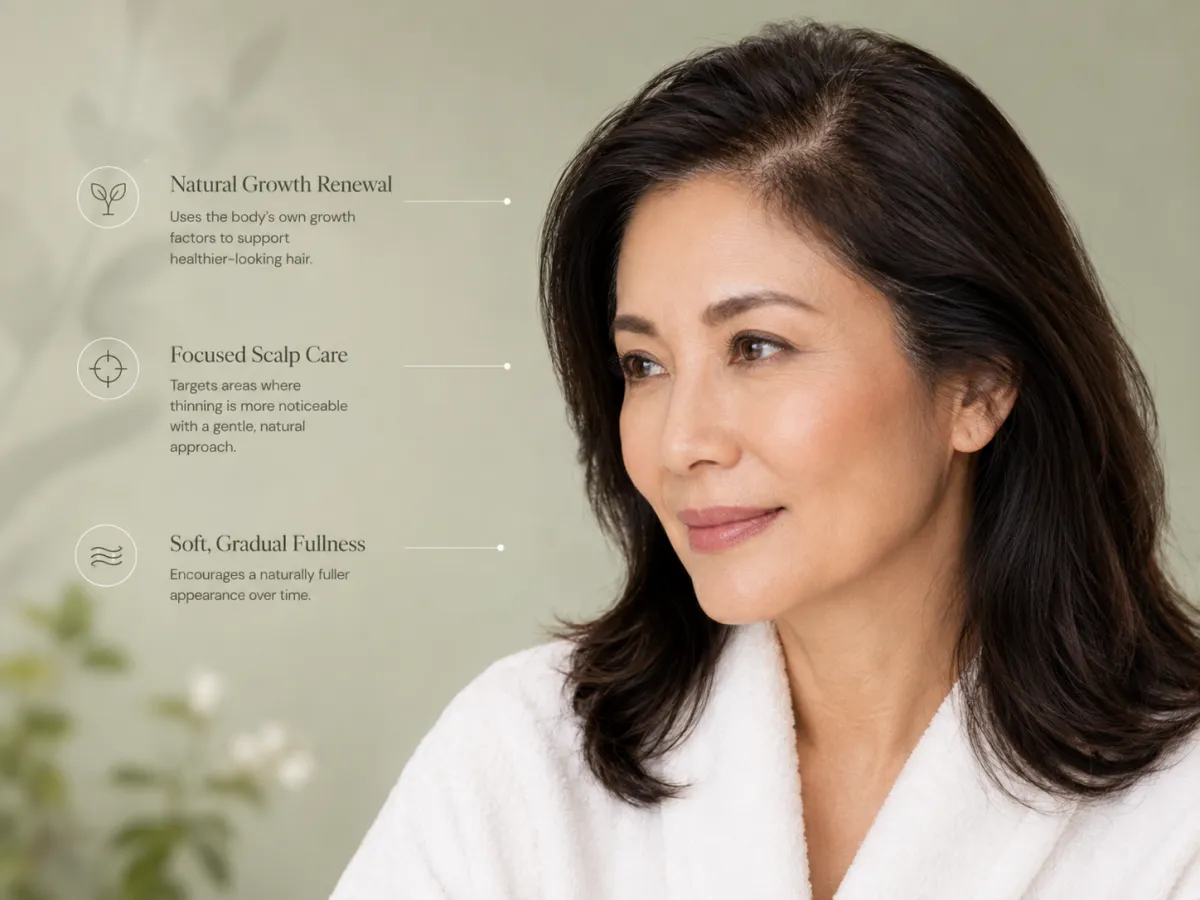
PRP for Hair Loss: A Natural Solution for Female Hair Thinning
The Hair Loss Conversation Nobody Really Wants to Have (But We Need to Talk About It)
Here's something that doesn't get talked about enough: hair loss is affecting so many women in their 40s and 50s in Burlington, Ontario, and across the Greater Toronto Area. And I'm not just talking about women going through menopause (though that's definitely part of it).
You might have noticed your part getting wider. Your ponytail getting thinner. Your hairline receding just a little. The amount of hair in your brush is... concerning.
And you might feel like you're the only one dealing with this, but you're not. Hair thinning is affecting millions of women. The problem is, we don't talk about it the way we talk about wrinkles or under-eye circles.
But here's the good news: unlike in the past, we now have real solutions. And one of the most effective is something called PRP therapy.
If you're in Burlington, Ontario, or the surrounding Halton Region, Luna Med Spa can help you restore your hair naturally.
What's Actually Happening to Your Hair?
Before we talk about solutions, let's understand what's going on.
Hair loss in women is usually caused by:
Genetics: If your mom or grandmother had thinning hair, you're more likely to experience it. Thanks, family genes.
Hormonal changes: Menopause, thyroid issues, or even stress can mess with your hormones and cause hair to thin.
Age: Natural aging means your hair grows more slowly and individual hairs get thinner.
Lifestyle: Poor nutrition, stress, lack of sleep, and even tight hairstyles can contribute.
Medical conditions: Thyroid problems, anemia, autoimmune conditions, and others can affect hair growth.
The good news? Most hair loss in women isn't permanent baldness like some men experience. The hair follicles are still there, they've just gone dormant. They're sleeping, basically.
And that's where PRP comes in.
How Your Hair Actually Grows (The Brief Version)
Each hair on your head goes through cycles:
Growth phase (Anagen): Hair is actively growing. This lasts 2-7 years.
Transition phase (Catagen): Hair stops growing and prepares to shed. This lasts 2-3 weeks.
Resting/shedding phase (Telogen): Hair falls out and is replaced by new growth. This lasts about 3 months.
Normally, most of your hair is in the growth phase. But as we age, or due to hormones, stress, or genetics, more hair shifts into the resting phase. This is when you notice thinning.
Enter PRP: The growth factors and healing cells in PRP essentially tell those dormant follicles, "Hey, time to wake up. Time to grow."
What is PRP for Hair, Exactly?
PRP (platelet-rich plasma) for hair restoration is the same treatment we talked about before, but applied specifically to your scalp.
Remember the basic idea? We draw a small sample of your blood, spin it to concentrate the healing platelets and growth factors, and then inject that concentration into your scalp.
These growth factors then:
Wake up dormant hair follicles.
Improve blood flow to the scalp.
Reduce inflammation that might be hindering growth.
Stimulate new hair growth.
Make existing hair thicker and stronger.
It's basically giving your scalp the nutrients and signals it needs to do what it's supposed to be doing.
The Science Behind Why PRP Works for Hair
I know this is getting a bit technical, but understanding the "why" helps you understand why this really works.
Platelet-rich plasma contains growth factors that include:
PDGF (Platelet-Derived Growth Factor): Promotes cell growth and tissue repair.
VEGF (Vascular Endothelial Growth Factor): Creates new blood vessels, improving circulation.
FGF (Fibroblast Growth Factor): Stimulates cell growth and collagen production.
EGF (Epidermal Growth Factor): Promotes skin and hair cell growth.
These aren't made-up chemicals. They're actual growth factors your body naturally produces. PRP just concentrates them.
When injected into your scalp, these growth factors get to work reactivating your hair follicles at the cellular level.
Studies show:
70-80% of women who get PRP for hair loss see improved hair density.
Most see visible results within 3-4 months.
Results continue improving for up to 6 months.
Hair is noticeably thicker and healthier-looking.
Results last 12-18 months (then you can do maintenance treatments).
Your PRP Hair Treatment Journey at Luna Med Spa
Before Your First Appointment
A few things to do beforehand:
Stay hydrated (drink lots of water).
Avoid blood-thinning medications like ibuprofen for 3-5 days before.
Avoid blood-thinning supplements (garlic, ginseng, omega-3s, check with us first).
Avoid alcohol for 24 hours before.
Don't take aspirin.
Get a good night's sleep.
Why? Because these things can increase bruising and affect the quality of your PRP.
The Day of Your Treatment
You'll come in and we'll draw a small sample of blood (yes, just like a regular blood test).
While your blood is being spun in the centrifuge (about 10-15 minutes), we'll apply numbing cream to your scalp.
Once your PRP is ready, we use a tiny needle to inject it into the areas where you have thinning hair.
The injections are spaced about a centimeter apart, targeting the hair follicles.
You might feel slight discomfort or pressure, but it's not painful thanks to the numbing.
The whole appointment takes about 45 minutes.
Immediately After
You might have some redness and mild swelling (normal).
Possibly some slight bruising (usually minimal).
Your scalp might feel tender for a day or two.
You can wash your hair tomorrow (gently).
The Results Timeline: When Will You See Hair Growth?
How Many Treatments Do You Need?
This is the practical question, right?
Most women need 3-4 initial treatments spaced 4-6 weeks apart for optimal results.
Think of it this way: one treatment wakes up some dormant follicles. Multiple treatments ensure most of your thinning areas are addressed.
Timeline for best results:
Treatment 1: Today.
Treatment 2: 4-6 weeks later.
Treatment 3: 4-6 weeks later.
Treatment 4: 4-6 weeks later (optional, but often recommended).
After your initial series:
Maintenance treatments every 6-12 months (just one session) keep your results going.
Many women stretch maintenance to every 12-18 months.
So it's a commitment upfront (3-4 months to complete the initial series), but then it's pretty minimal ongoing.
Can You Actually See Thicker Hair? Real Results
What you'll actually see:
Hair that feels thicker when you run your fingers through it.
A wider, fuller-looking ponytail.
Your part looks less wide.
Overall head of hair looks denser.
Baby hairs (peach fuzz) around your hairline and scalp (this is new growth!).
Hair breaks less because it's stronger.
Before & After: What's Realistic?
Here's the thing about PRP hair results: they're real, but they're not the same as hair transplants or extensions.
You won't go from a visible scalp to a full head of hair overnight. That's not realistic, and we won't promise that.
What IS realistic:
Going from noticeably thin to full and thick.
Wider areas of thinning becoming less noticeable.
Overall density increasing significantly.
Hair that's visibly healthier and stronger.
The before/afters you see at legitimate clinics like Luna Med Spa show real results. Some women's transformations are more dramatic than others (genetics, severity of hair loss, and age all factor in).
During your consultation, we can show you realistic before/afters and discuss what you can realistically expect for your specific situation.
The Cost: Is This Worth the Investment?
PRP for hair typically costs:
Per session: $400-$800 (varies by clinic and location).
For initial series (4 sessions): $1,600-$3,200.
For maintenance (1 session/year): $400-$800.
Yes, that's an investment. But consider:
Hair transplant surgery: $4,000-$15,000+, requires actual surgery, 6+ months of recovery.
Hair growth supplements/products: $30-$200/month, often minimal results, ongoing cost.
High-quality wigs or extensions: $500-$5,000, need constant maintenance.
PRP: One-time investment with 12-18 month results, minimal maintenance needed.
When you look at it that way, PRP is actually pretty affordable compared to other options.
Plus, you're growing yourownhair. It's low-risk and natural.
Side Effects: The Honest Version
PRP for hair is incredibly safe. Most side effects are minor and temporary:
Possible side effects:
Tenderness in the scalp (a few days).
Mild bruising (rare, easily covered with hair).
Slight swelling (goes down in 24-48 hours).
Temporary shedding (this is actually normal and not a sign it's not working).
Serious side effects:
Extremely rare. Infection is possible but uncommon with proper sterile technique.
Impossible side effects:
Allergic reactions (it's your own blood), hair color changes, texture changes.
Honestly, most women tolerate it really well.
Who's a Good Candidate for PRP Hair Treatment?
PRP for hair works best for:
Women with early to moderate hair thinning.
Those whose hair follicles aren't completely dead (if you have dormant follicles, we can wake them up).
Women who notice gradual thinning.
Those with female pattern hair loss.
Anyone looking for a natural solution without surgery.
PRP might not be ideal if:
You have complete baldness (no hair follicles left to stimulate).
You have certain blood disorders.
You're pregnant or breastfeeding.
Your hair loss is caused by an active infection or uncontrolled medical condition.
We'll assess your individual situation during your consultation at Luna Med Spa in Burlington.
Can You Combine PRP Hair Treatment with Other Things?
Yes, absolutely.
PRP + Hair Growth Supplements:
Many women take quality hair supplements (biotin, collagen, etc.) while doing PRP. They work together.
PRP + Hair Care:
Using a good shampoo and conditioner for thinning hair amplifies results.
PRP + Topical Hair Treatments:
Some women use minoxidil (Rogaine) alongside PRP. Your doctor can advise if this is right for you.
PRP After Hair Transplants:
If you've had transplants in the past, PRP can help maximize and maintain those results.
We'll discuss what combination makes sense for you.
The Real Talk: Is This Permanent?
Okay, let's be honest about what PRP can and can't do.
PRP wakes up dormant hair follicles and stimulates new growth. But it doesn't cure the underlying condition that caused hair loss in the first place (whether that's genetics, hormones, or age).
This means:
You'll see real results that last 12-18 months.
You'll likely need maintenance treatments to keep results going.
It's not a one-time fix that lasts forever.
But here's the thing: that's still better than most options. And you're working with your body's natural processes, not against them.
Think of it like exercise. You exercise, you get in shape. If you stop exercising, you slowly get out of shape. But that doesn't mean exercise didn't work, it means you need to maintain it.
Same with PRP and hair.
Real Women, Real Results
Ready to grow your hair back?
Come in and let's talk about your hair loss and what's possible for you. We'll assess your hair, discuss your goals, and create a personalized treatment plan.
FAQ: PRP Hair Loss Questions Answered
Q: Will PRP work if my hair loss is due to menopause?
A: Often yes. Menopause-related hair loss is sometimes reversible with PRP because the follicles are dormant, not dead.
Q: How long after treatment can I wash my hair?
A: You can wash gently the next day. Wait 24 hours and use lukewarm (not hot) water.
Q: Will the results look natural?
A: Yes. You're growing your own hair, so it looks completely natural.
Q: What if I'm currently taking hair loss medication?
A: That's fine. PRP can work alongside medications. Tell us what you're taking.
Q: Can men get PRP for hair loss?
A: Absolutely. PRP works for male and female pattern hair loss.
Q: Do I need to avoid the sun after treatment?
A: Not really, but some sun protection doesn't hurt.
Q: Will my hair grow really fast?
A: Hair growth happens at a normal pace (about half an inch per month). You're just waking up dormant follicles, not creating superhuman hair growth.
Q: Can I get a hair color treatment after PRP?
A: Wait at least a week, and be gentle with your scalp during coloring.
Q: Is there any chance this won't work?
A: PRP has an excellent success rate, but individual results vary. That's why we assess your specific situation first.
Luna Med Spa - Hair Restoration Experts in Burlington, Ontario
Located in Burlington, Ontario, Luna Med Spa specializes in PRP hair restoration for women experiencing hair thinning. Serving the Greater Toronto Area, Halton Region, and surrounding communities with natural, non-surgical hair growth solutions.
Don't accept hair loss as inevitable. Contact Luna Med Spa for your hair restoration consultation today.
3455 Harvester Rd, Unit 10, Burlington, Ontario L7N 3P2